Spirits and Dark Matter
Ever since it was postulated in the early 1930’s, dark matter has been a mystery of physics and cosmology. Scientists have proposed countless theories and have done nearly as many experiments trying to detect and explain the phenomenon.
In a nutshell, scientists discovered that everywhere they looked in the universe, gravitational laws indicated that the observable motion of celestial bodies (stars and such) behaved as though there was more mass out there than we could see – a lot more. This invisible matter was dubbed “dark matter.”
As the measurements and calculations have been refined – assuming our understanding of the law of gravity is accurate on the scale of galaxies – the estimates of the amounts of dark matter and dark energy in the universe have been calculated to far outweigh the amount of visible matter and “normal” energy. See the graph (from Wikipedia) below:
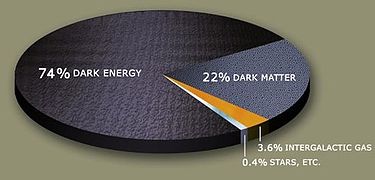
While science has not been able to come up with much in terms of explanation or even detection of dark matter and dark energy, in 1843, Joseph Smith recorded a revelation that at least partially explains dark matter:
“There is no such thing as immaterial matter. All spirit is matter, but it is more fine or pure, and can only be discerned by purer eyes; We cannot see it; but when our bodies are purified we shall see that it is all matter.” (D&C 131:7-8)
That spirits were matter at all was a revolutionary concept at that time, but if we consider spirits to be made of dark matter, this becomes a key intersection between religion and science as to what can be real.
Although there are a lot of forms of invisible matter, the attributes of spirits indicate that they are made of a type of matter not yet understood by science, hence my classification of it as a form of dark matter. There is also some anecdotal evidence of spirits having a measurable weight in the experiments of Duncan MacDougall, which would support this theory.
While this is a mildly interesting thing to contemplate by itself, when we start considering the ramifications of this assertion, we find a number of potentially useful insights that could lead to greater understanding of dark matter.
First, let’s consider the nature of spirits. A spirit is the essence of the consciousness. To be complex enough to contain a consciousness, we need to have matter with properties that both allow aggregation and binding together, as atoms and molecules do with regular matter, with substantial complexity. To attain such a level of complexity requires particles which can be combined in many different ways. This would be further enabled by the existence of different types of particles. So, there are likely at least several different kinds of dark particles with different properties, which may be able to be combined into many different dark elements, and dark molecules.
Dark matter is affected by gravity, as that is how we know of its existence. We also know that spirits animate the physical body, so there is likely some potential for these dark particles to interact with the other forces (electromagnetic, strong force, weak force) that govern the behavior of regular particles. Alternatively, there could be some other force between dark particles and regular particles that allows them to affect each other – perhaps dark particles could affect quantum spin, for instance.
Considering these points and the fact that spirits are animate, it should be no wonder that the scientific community has had little luck detecting this kind of dark matter. The tests typical of the general scientific community look for as-yet-undiscovered particles consists of breaking apart or fusing known particles or waiting for stray particles to pass through their detection devices by chance.
I don’t know how to best to detect particles that may or may not be affected by the forces we currently understand and which may or may not be collected together in regular patterns. However, much of scientific progress starts with a hypothesis.
On the religious side, the quantity of dark matter in the universe indicates that there could be a lot more to the spirit world than we might guess.
Ultimately, the key point here is that spirits are real. Despite the inability of modern science to detect them, we have very good, logical explanations for how they can exist that fits the observed facts.
Terminology Change
A Facebook friend of mine, Matt Browning, pointed out to me that the term “Scientific Fundamentalism” has already been defined as the opposite of religious fundamentalism: believing that there is no knowledge but that provided by science, and that nothing else has any value whatsoever. (Pardon my paraphrasing.)
Since this is definitely not what I meant by it, I will begin using the term “Enlightened Fundamentalism” instead. I will be revising my previous posts and tags accordingly.
Special thanks to Justin Kunz for his suggestion.
Genealogy According to Mormons
This is an article I wrote years ago – before blogs existed. It has been published in the newsletters of several different genealogical societies and used to be the top reference on About.com for Mormons & Genealogy. I have updated a little bit at the end to account for recent events…
Members of The Church of Jesus Christ of Later-day Saints (Mormons) are prolific genealogists. Genealogical societies aside, one would be hard-pressed to find another religious, social, or political group that engages in more genealogy per capita. The two main reasons for this are rooted in the culture and doctrines of the Church.
Culture. Mormons conduct genealogy for many of the same reasons others do. It can be very interesting to learn about one’s ancestors, how and where they lived, and what they experienced. We can learn much about our culture, heritage and traditions by researching our ancestors. It can also bring family closer together, and help reunite family branches.
Additionally, since the early years of the Church (1830s-1840s), members have been encouraged to document their lives and experiences through journals and other family records. As a result, members who have Mormon ancestors often have much more information with which to begin their research.
However, if culture were the only reason Mormons researched their genealogy, the proportion of Mormon-genealogists would probably be no more than that of any other group. The most significant difference is rooted in Church doctrine surrounding the afterlife and the “saving ordinances.”
Doctrine. “Ordinance” is the general term used by the LDS Church for what many other Christian denominations term “sacraments.” They are the basic rituals performed by church members, often becoming rites of passage through life. “Saving ordinances” are the ordinances required for salvation; they include baptism, confirmation, endowment, and sealing. Sealings are the LDS version of marriage – instead of the more common “till death do you part,” a couple is “sealed” for time and all eternity to each other and to any children they might have under such a union. Endowments have no equivalent that I am aware of. While regular baptisms and confirmations are held in chapels, where anyone may attend and observe, endowments and sealings are performed only inside temples of the Church.
The Church’s doctrine states that the saving ordinances must be performed with the proper (LDS) authority, and – significant to our discussion of genealogy – must be made available to every person who has ever lived. Therefore, to make them available to people who did not have the opportunity while living, they may be performed upon a living member of the church as a proxy for a deceased person. Ordinances for the dead may only be performed inside a temple for a known individual or, in the case of sealings, for a known couple or family. Through genealogy, we can find individuals and link them to their families.
Public Relations. Here is where some of the unintentional side-effects begin. Because the doctrine states that every person must have the opportunity to accept the saving ordinances in either life or death, Church members were eager to perform as many of these ordinances as they could. When the church operated in relative obscurity, they were able to perform ordinances for most any deceased individual they could find. Hardly anyone in mainstream society cared what Mormons taught or did, and the Mormons of that time gave little thought to what the rest of society might have felt if they had known who the Mormons were baptizing by proxy. Many early church leaders and members performed “temple work,” as saving ordinances for the dead are often called, for figures such as the Forefathers of the United States of America and Columbus, and ancestors of people of other religions. They would often select candidates who had contributed to the conditions that allowed the Church to come into being, or arbitrarily by the availability of the genealogical information.
With the Church becoming more mainstream, non-Mormons have taken more note of the actions of the Church and its members. Some whose ancestors have been baptized by proxy have been offended. Some feel that their ancestors would not have wanted any relations with the Mormon church. Others feel that they should have been asked permission. Others are offended by the Church’s claim that it has the only valid authority to perform baptisms, and that baptisms into other Christian faiths should be recognized. While the Church makes no apology for the doctrine or the performance of such ordinances, we understand the emotions. Even though the doctrine states that a deceased individual has the right to accept or reject the ordinances done on their behalf, in 1995, Church leaders reacted to outsiders’ complaints and asked members to only submit names of their own ancestors for temple work.
However, it is still possible that someone who is not a Church member may find that an ancestor has had temple work done for them. Usually, this indicates that you may have a distant relative who is Mormon. It could mean that the temple work for that individual was done before the Church asked members to only do the work for their own ancestors. Unfortunately, there have also been cases of members not following the guidelines. After a recent case of this that got a bit of media attention, the Church sent out an email to all registered users of their online genealogy site, familysearch.org, reiterating the 1995 position of the Church and implying that offenders could be blocked from the site for infractions.
An immense resource network has been made available to all genealogists-a result of the Mormons’ zealousness for genealogy. None of this would have happened without the additional doctrinal motivation. Hopefully, the misunderstandings that have arisen due to the practices of the Church can be overcome by conversations and articles such as this one.
Reconciling the Creation, part 2
So, in part 1, I started it off explaining how I believe in the Creation, but not quite literally as outlined in the scriptures. I was just getting started explaining how the story of the Creation might apply to how the Earth was actually formed.
I don’t believe the Creation started from nothing. In describing the Earth as “without form and void,” (Genesis 1:2) why should we assume the void of space? I’m not an etymologist, but I’m pretty sure the term “void” has not meant a vacuum until fairly recently, historically speaking. I interpret it, therefore as “empty” or “without purpose.” Without form, I interpret as being in a state of raw materials. So, in my opinion, the earliest the Creation would have started in terms of the “days” was well after the formation of the planet.
I should probably also say that the “days” are a pretty arbitrary construct. In the LDS Church, they are sometimes referred to as the “creative periods.” It is also my understanding that the original Hebrew word does not translate directly into “day” and also supports the “period” interpretation. So, with these assumptions changed, we’re suddenly looking at a scenario that can be reconciled with science; the Earth was formed from raw materials over a (really long) period of time.
The first thing God does is the creation of light and the separation of it from the darkness. What does this mean? If we take “light” and “darkness” as symbols, meaning jumps out. He separated the good from the bad. He was an engineer and this was the design phase of the project. He defined the purpose, created a plan and organized his resources.
Following on the same train of thought, on the second and fourth “days” He created the foundation and infrastructure for the project. There is a lot here that I don’t understand. Why does he have to create Heaven? What do the waters symbolize? How could plants have possibly come before the sun and moon? I suspect that all of this is symbolic more than literal, still. I’d love to hear ideas on this.
The first living things created are plants. This makes sense, of course given that all energy for life has to come from the sun and plants are how that light energy is converted to chemical energy, thereby making it available to other organisms in the food chain.
The next life created is in the seas and the birds. I’m also not a paleontologist, so I don’t know when birds came along in the evolutionary chain of events relative to land animals.. It could be their mention here is more symbolic, placing them “below” the land animals. Or perhaps it’s just for narrative convenience in order to leave the sixth day for land creatures.
In any event, the sequence of things is similar enough to the evolution that occurred according to the current understanding of the history of life on this world that I do not feel any contradiction of the scientific understanding of things, including the theory of evolution. It certainly does not imply evolution, nor does evolution support the exact narrative supplied, but when we are looking at this from a less literal perspective, the apparent conflict turns into harmony. It is my belief that God used his knowledge and power to cause evolution.
I would also point out that believing that God guided evolution makes evolution itself a stronger theory. According to the second law of thermodynamics, all closed systems gradually decay into a state of the lowest possible energy, in other words, into their most disorganized state. Evolution from random amino acids to single-celled life to human is in direct opposition to this law. Evolutionists will typically tell you this is because the Earth is not a closed system – the sun provides energy for this transformation. Yes, it is true that if you build a solar oven, and put cake batter in it, you can bake a cake. However, if you leave the batter in the sun indefinitely, it won’t turn into cake, it will dry out, and turn into dust. The solar oven and knowledge of when the cake is done is a critical element. Random changes to genomes is far more likely to result in a species’ extinction than its survival. Without God guiding it, evolution does not make sense.
So, the Creation story all leads up to the creation of the human being, and similarly, the most evolutionarily advanced species on the Earth is the human being. Humans are the supreme product of both processes. Of all the species on this planet, only people have the capacity to significantly and willfully alter our environment. Many will tell you this a trait that evolved in us. I, obviously, believe it was it God-given.
I would further argue that it makes more logical sense to believe that our difference from other species is due to our relationship to God, than it is attribute it to evolution. Scientists have studied this a great deal, and have had many theories as to what sets Homo sapien apart from other animals. They once believed it was opposable thumbs which allowed the use of tools. Many other animals have since been documented to use tools. Others postulate that language is the key differentiator. However, many modern studies have shown many animals have a significant ability to use language. There have been other theories, too, but none have achieved broad general acceptance.
On the other hand, if you accept that God made us above the animals you have a new set of possible hypotheses. I’ve heard that some Christian faiths believes Humans are the only life forms with a soul or spirit. The LDS Church teaches that all living things have a spirit, so we can’t rely on that. You could also theorize that it is because God is our Father. That answers the question, but is not terribly specific. I would assert that the difference is that of free will, or as the Church calls it, agency. We are the only living things with the power to make our own decisions and decide our own fate. Animals are bound by their instinct, training and environment.
To sum up, God had a plan. He organized the world in order to create human beings. He guided and controlled natural processes in his creation. It is no less miraculous thus explained, just more real.
So, this gets us through the literal creation. What do you think? I think I’m going to stop here for now and take on the symbolism in yet a 3rd part.
Reconciling the Creation, part 1
Following on the theme of scientific fundamentalism, let’s consider the Creation. Obviously, the Earth was not created either from the absence of matter or in six days. We do, however, believe that the Earth was “created” for us. So, where does that get us?
To some degree we have to treat the Creation story as a myth. Unless you are a strict fundamentalist, it seems clear that the story serves more to communicate the way God works than it provides a strictly literal account of how the Earth came to be. We have to remember that the prophets who were given the revelation of the Creation could not possibly have understood the complexities involved in plate tectonics or the movement within the solar system, for instance, let alone communicate that to their fellow believers.
Now, we don’t typically use the term ‘myth’ in the LDS Church when speaking of scriptures, even if some might argue that is the correct word in certain circumstances. The term used by the Church in these scenarios is “symbolic.” The key difference, at least in the common vernacular, is that myths are seen as misleading or uninformed, whereas symbolism is used specifically to teach. So, what is it that the story of the Creation is meant to teach? I’d like to approach this question in two ways. First, I’ll analyze how the story might be interpreted to apply to the actual formation of the world, then I will discuss the purpose behind the symbolism in the story.
Just so you know, I’ve thought about this a reasonable amount, but I will definitely be making some of this up as I go, so feel free to offer different interpretations or punch holes in my logic. 🙂
Members of the LDS Church are fortunate when it comes to the Creation, in that we have several accounts in our scripture, each of which emphasizes slightly different points. So for instance, although the Biblical account starts with, “In the beginning God created the heaven and the earth,” (Genesis 1:1) the account from the Book of Abraham uses the phrase, “And they went down at the beginning, and they, that is the Gods, organized and formed the heavens and the earth.” (Abraham 4:1)
Right off the bat, there are several key differences. Rather than “created,” we have “organized and formed.” We also have multiple actors in the account from Abraham. When something is organized or formed, it is accomplished with materials already existing. This is an important point for me, as we know from the principle of conservation of mass, that matter cannot be created or destroyed.
I also appreciate the multiple actors. It allows us a glimpse into what it means to have the power of God, in that it’s not necessarily about the power to cause wondrous things to happen with just your mind, but rather about providing a vision of something great and having the leadership to make it happen. What I would specifically like to de-emphasize here is the concept of multiple gods. Abraham came from a culture that believed in multiple gods with a complex hierarchy, and was merely using the language understood by those around him. A more accurate description would be, “heavenly beings.” In fact, there are places in Mormon doctrine that identify us – that is the pre-mortal spirits of the people who have inhabited this planet – as those beings who helped with the Creation. (I don’t have a source on this now, but I’ll look for it.) Despite this, it is right to still consider the Earth God’s creation. Do we not also give credit to great individuals for leading others to great accomplishments? (“He/She single-handedly turned around the company/won the war/brought peace/etc.”)
I don’t intend to belittle the power required for the Creation, as it is still, even with my proposed interpretation, far beyond anything mortal humans could hope to accomplish. However, to understand God is to know God, “and this is life eternal, that they might know thee the only true God, and Jesus Christ, whom thou hast sent.” (John 17:3) This is my search for understanding.
It’s too late, so I think I’ll post this in multiple parts… Next up the “days” of the Creation.
Enlightened Fundamentalism
The term “fundamentalist” is not one used in the Mormon church. As a result of this and growing up in Utah, I never heard it applied to churches or believers until high school or college. In figuring out what it meant, I have felt that there are definitely ways in which it applies to the LDS Church, albeit with caveats.
We believe in miracles, angels, revelations, the Creation and that God the Father was the literal father of Christ. So, what is it that makes us different from other fundamentalist religions? In one word, science. We believe in all truth, whether revealed to prophets or discovered by scientists. Fundamentalism, on the other hand, generally refuses to acknowledge science unless it agrees with established belief.
So, I’ve come to think of our kind of beliefs as “enlightened fundamentalism.” Meaning that we believe in the power of God, but also believe that God is limited (as we all are) by reality — laws of physics. We do not pretend to understand HOW God does what he does, but we believe that he does it through a perfect understanding and ability to manipulate (as scientists do) an environment.
Here are some of the doctrines that enable this kind of enlightened fundamentalist view:
- “In the Church, we embrace all truth, whether it comes from the scientific laboratory or from the revealed word of the Lord. We accept all truth as being part of the gospel.” – Russell M. Nelson, Apostle
- God, angels and spirits are all composed of some form of matter. “There is no such thing as immaterial matter.” D&C 131:7
- We strongly support education. “Seek ye diligently and teach one another words of wisdom; yea, seek ye out of the best books words of wisdom, seek learning even by study and also by faith.” D&C 109:7
- God can inspire us to help us learn non-religious truths. “And by the power of the Holy Ghost ye may know the truth of all things.” Moroni 10:5
Now, the challenge is that no matter how much we learn (time machines excepted), we will never be able to go back in time and use whatever new-fangled scientific tools we might have to detect the actual processes whereby miracles were wrought. So, even if we get to the point where we can explain miracles or detect the presence of spirits scientifically, there will always be at least some amount of uncertainty that requires a leap of faith.
Therefore, for me, the purpose of science in enlightened fundamentalism is not to provide proof or repeatable results, but rather to link together enough information to be able to hypothesize a feasible process that meets our understanding of reality and religion, and that allows a glimpse of the power required to work miracles.
The simplest example is that of how God might cause a person to have a vision. We know from science that all perception is processed through electrical activity in the brain. Because spirits work in the physical world, and people are composed of a body and a spirit, it would be expected that spirits would have some way to affect the electrical signals in the brain. We also know from science that matter is mostly empty space, so there would be no reason why a second spirit could not manipulate the brain concurrently with another through direct contact, in order to “send a message.” (Hence the importance of Enmity, by the way.)
Do we know that this is how it works? Absolutely not. It is, however, a reasonable hypothesis in harmony with both science and the doctrines of the church. It also illustrates the point that science and religion can be used together in the search for truth. We need not assume (as seems to be the popular wisdom these days) that they are contradictory by nature.
When we believe miracles are impossible, its very hard to have faith. When we can imagine processes that would produce miracles, it allows our faith and our understanding to flourish.
Why “Member Missionary Work” Fails
(Reposted from my old blog…)
As members of the LDS Church, we are frequently encouraged to be more actively engaged in “member missionary work.” Interestingly, although “member referrals” are the largest source of converts for the church (yes, the church does track this – rather carefully, actually), and we have one of the largest missionary populations of any religion, we, as members, are still not very good at being missionaries in our daily lives.
The problem IMHO, it that there is a perceived conflict of interests between being a friend to someone and trying to proselytize to them. It is very difficult to, say, ask a friend if they want to listen to missionaries from the church without it coming off a little weird or forced. Depending on the relationship, some people might even take offense. Obviously, we want to avoid offending or even sounding weird to our friends. However, without such an invitation, a friend is not likely to ask if you wouldn’t mind sending missionaries over to their house.
The church leaders have recognized this issue, and for many years have focused on encouraging members to ‘prepare’ your friends to hear the gospel. This is exactly what needs to happen. Unfortunately, it can be very difficult to determine what you need to do to ‘prepare’ your friends for this type of thing. So, naturally, the church (as it has done with many other things) has prepared a curriculum of sorts: a list of things you can do to prepare someone to hear the gospel, one of these tools is known as the ‘set a date’ program.
The merits of ‘set a date’ program and other lists of suggestions aside, I have never known this type of planned approach to be successful except anecdotally. The reason is because it does not address the issue BEHIND the perceived conflict of interest.
What is that issue, you ask? It is that it is extremely difficult to integrate a perceived ‘normal’ external appearance with our beliefs as members of the Church. Our beliefs just don’t ‘fit in’ to the regular hubbub of modern society – especially when you are speaking to people who are not members of the Church.
I’m not talking about devotion or balance or anything about how we live as active members of the church. Most of us are very good at being religious in that sense. It’s more about how we integrate the gospel into the fabric of our inter-personal relationships, about making our beliefs known to others, not because of any agenda we have to ‘be an example’ or ‘share the gospel’, but because it is an important part of who we are.
I started to recognize when I was in college, that I didn’t really have any really close friends. Most of my friends were of other religions or no religion at all, and I did not have any daily contact with any other members. I realized that part of the reason I did not have any close friends was that because the gospel was such an important part of my life and my identity, and I treated it as something ‘special’ to be shared only in certain circumstances, that nobody really understood me well enough to be a truly close friend.
As I realized this, I made steps to correct it. It’s not like I had been hiding my religious beliefs before. On the contrary, I would gladly talk to people about the Church, and even made a lot of effort to give away a number of Books of Mormon. However, I started to approach my sharing of my beliefs not as a duty or as a missionary tool, but as a way to help people get to know me, and as a way to try to relate to the world and the beliefs of others.
By the end of my college years I had gained two very close friends. Both are not Mormon to this day. However, I was able to talk openly about the church with both of them and invited them to do a number of things that they would not have been likely to do otherwise, and which did not affect our relationship negatively in any way. On the contrary, it is because I was “spiritually intimate” (for lack of a better phrase) with them that we became so close. Inviting them to church or to read the Book of Mormon was just another part of our relationship.
Now, I’m not saying that we need to become best friends with people before we can invite them to listen to the missionaries or to church. What I’m saying is that if you create your relationships from the beginning on a foundation of openness about your own beliefs, it is much easier to open your mouth, when you suddenly feel prompted to say, “you know, I think you might enjoy coming to [such-and-such activity] with me,” or “this reminds me of a scripture from the Book of Mormon where…” or “why don’t you come to church with me Sunday?”
I often think of gospel parallels and insights when speaking to others that I often ignore. Even when speaking with other members, there is a tendency to filter out anything that might not be in-line with standard doctrine. It is important for all of us to learn to communicate openly about all of our beliefs. Often we have similar questions to those around us, and someone may be able to help us work out answers to those questions, or we can help someone through our insights. However, if we do not open our mouths and say what we think, feel and believe, we isolate ourselves a little more from those around us.
It’s really more about being comfortable being a ‘peculiar people.’ We need to embrace our beliefs and have the courage to be a lone voice for anything we believe to be true.
The Logical Mormon
I’ve always been fond of puzzles and logic. In many ways this has shaped my view of the world and my approach to life. When met with a question or problem I treat it as something to be answered or solved, not an obstruction. All questions have answers and all problems have solutions – for those who are willing to take the time to find them and who are willing to accept the answer or solution they find.
I have always enjoyed the process of using logic to answer a question or solve a problem: starting with a set of assumptions and then using knowledge of relevant facts to reason out a set of possible answers and then examining each solution to pick the best fit. When I was growing up, I assumed that everyone approached questions this way.
Growing up, I used to think that I could show someone the truths of the Gospel through logical argument in a way that would make it impossible to disbelieve, if only they would take the time. I was awfully naïve. However, this naïve belief was a product of a religious upbringing that embraced logic and reason.
It is a doctrine of The Church of Jesus Christ of Latter-day Saints (LDS Church or Mormon Church) that “all truth can be circumscribed into one great whole.” The only difference between truths of the Gospel and truths of the laws of physics are in the way they are discovered and how they are applied to our lives.
I hope to use this blog as a platform to both help other members of the Church who may have questions about seeming incongruities between science and the Gospel and also to explain our beliefs to people who are not members of the Church in a hope of fostering better communication and understanding.
I do not pretend to write on behalf of the church. Though I believe everything I plan to write to be in harmony with the teachings of the church, there may be points that other members or leaders of the church might dispute if they happen to read them. In particular, one of the things that I hope to do is discuss the reasoning behind my belief in the doctrines, which is something that is generally very different for each individual. I will try to make the distinction between my thoughts and Church doctrine clear.
 The Logical Mormon