No Offence…
This is an excellent post on being offended. I particularly like how she considers dwelling on the offence taken by others as a form of being offended. Learning how to not be offended is an important principle in achieving personal peace and happiness.
The Requirement of Baptism
Just a quick note before I begin: I have fallen out of the habit of making time to post due to a recent new addition to our family, so determined that the best thing I can do is to post something to kick start the good habit again. There are other posts I have been working on and which I want to write more than this one, but as I gave an Elder’s Quorum lesson on this recently, I’m hoping it will flow quickly.
“Except a man be born of water and of the Spirit, he cannot enter into the kingdom of God.” (John 3:5) That is the requirement. It is a requirement is so deeply understood in Christianity to the point that many sects baptize infants and/or teach that anyone, no matter how good, who is not baptized, is damned. In fact, it is so important to the gospel that even though it is intended for the “remission of sins” (Mark 1:4) Jesus, the only sinless person to live on the Earth, confirmed and clarified the requirement by getting baptized himself.

But there is a second part to that requirement, that of being “born…of the Spirit.” This is a little less clear in the New Testament, but it is there. This refers to the sanctification that comes as a result of the Gift of the Holy Ghost. (Note the capitalized “Gift”.) It is not always mentioned in conjunction with baptism in the scriptures, but there are two places in the New Testament where it is explicit. One is in Acts 2:38 when Peter says “Repent, and be baptized every one of you in the name of Jesus Christ for the remission of sins, and ye shall receive the gift of the Holy Ghost.” The other is in Acts 8, when the Samaritans have accepted baptism but had not yet received the Holy Ghost, and only received it when John and Peter came to them and laid their hands on them in verses 15 to 17.
The LDS Church has some additional clarifying scriptures and doctrine surrounding the ordinances of baptism and confirmation (when the Gift of the Holy Ghost is conferred). First off, we affirm the importance thereof in the fourth Article of Faith and also in referring to them as the “saving ordinances.” We also believe in several technicalities surrounding the performance of the ordinances:
- Baptism must be done by full immersion.
- Both must be performed by someone with the proper authority.
- The individual must be prepared and willing to accept them.
- There is a proscribed prayer.
- It is only done for those who are at least 8 years old.
Needless to say, with all of these technical requirements, and our belief that the proper authority has been in short supply throughout history, it would be unjust of God to place such restrictions on entry into His kingdom. It is for that reason that we believe in and perform baptisms for the dead. Such baptisms are mentioned in the New Testament (1 Cor 15:29), but are largely doctrinally ignored by other Christian sects. For us they fill a very important role in supporting the logic of the Gospel. They allow God to be both merciful to those who would have willingly accepted baptism had it been available to them while also requiring it strictly for those to whom it is available. (I don’t want to get sidetracked into this further in this article, but I have written about it previously in Genealogy According to Mormons.)
As we believe that all will ultimately have the opportunity to accept baptism, I would argue that the central purpose of baptism is not salvation, but rather the covenant we make with God, that, if upheld by us, will result in salvation. The covenant is described several different ways in many different places, but it comes down to this, we are enrolling in the service of God. We become part of His fold and will attempt to do His will. We are signing up for a life of work, of service to our fellowmen, of constant personal refinement, and, in essence, to try to do the work He would do if He were on the Earth. If we make an earnest effort to do this, Christ’s Atonement will be applied and we will be saved.
Yes, the end result is (hopefully) salvation, but that is not the purpose. The purpose is to commit us to making ourselves into people worthy of salvation. This is a principle central to the Gospel as taught by the LDS Church. The purpose of religion is not to set up rules, but is rather for guiding the development of individuals to greater righteousness. That is why the Gift of the Holy Ghost is also a critical piece of the process.
The Gift of the Holy Ghost, as taught by the LDS Church, is only available to baptized and confirmed members of the Church, in contrast to the influence of the Holy Ghost, which is available to all. The main difference between these is that we have the right, inasmuch as we keep ourselves worthy, to the constant companionship of the Holy Spirit. Most people will feel the Holy Ghost when they are doing God’s will, whether they recognize it or not. With the Gift of the Holy Ghost, the gifts of the Spirit, as spoken of in 1 Corinthians 12, are made more powerful. We also believe the Holy Spirit can assist us in all parts of our life, whether or not it is directly related to God’s work; the Holy Ghost can be a source of inspiration in both secular and spiritual endeavors.
The Gift of the Holy Ghost also imparts a greater portion of the fruit of the Spirit. (Gal 5:22-23) Through the power of God and the direct influence of the Holy Spirit in our lives, we can find greater love, joy, peace, faith and happiness. Our efforts to find these in our lives are magnified by the Gift of the Holy Ghost.
This is really the core of what drives Mormons to proselytize. We have covenanted, through baptism, to do God’s work, and we are rewarded disproportionately by the Gift of the Holy Ghost when we do so. We have tasted divine joy and want to share. We have experienced the power of God through the Holy Ghost, and have had our lives changed. We’ve seen others’ lives changed through the same power. Our love has grown through the infusion of the Spirit. We rejoice in your happiness. We want to work with you so that we may all gain greater peace and happiness through Christ.
“Come unto me, all ye that labour and are heavy laden, and I will give you rest. Take my yoke upon you, and learn of me; for I am meek and lowly in heart: and ye shall find rest unto your souls. For my yoke is easy, and my burden is light.” (Matt 11:28-30)
Guns & the Gospel
You know, I grew up in a family with guns. I learned how to shoot targets in scouts. I appreciate the second amendment. However, at some point, you have to say, “enough is enough.” The ability to own a gun is the ability to take a life. Given the number of completely innocent lives taken in the past week, let alone year, we cannot stand by and do nothing to protect those innocent people.
I’m not necessarily saying we should dramatically cut gun permits, though that might be a good option. In my mind a better solution would be to have some real consequences for “innocent” gun owners whose weapons discharge accidentally or are used by someone else to commit a crime. If you are not taking care of your weapon sufficiently to protect its misuse, that is gross negligence, because you have delegated your ability to kill to someone else who was not responsible.
That is where I stand on gun laws. You can have your guns, as long as you take the responsibility for any life harmed by your guns.
As for myself owning a gun, I have no desire to do that. It seems clear to me that Christ’s teachings permit defending yourself and your family with bloodshed, but advise us to rise above violence. “But I say unto you, That ye resist not evil: but whosoever shall smite thee on thy right cheek, turn to him the other also.” (Matt 5:39)
Don’t get me wrong, defending the innocent is a righteous cause; preserving freedom is a just cause; upholding your right to worship the true God is a just cause, but none of these are a necessity. God will save the innocent – if not in this world, then the next. Our most important freedom, to choose our own actions, can never be fully taken from us. We can worship God in any circumstance. If we are righteous, God will fight our battles.
Yes, we live in a wicked world. There are serious threats to our physical and spiritual safety all around us. We need to be able to defend ourselves. You may choose a handgun. I will choose the armor of God. I can’t prevent all potential threats to my sons’ health, but I can prevent any accident that might arise from finding a gun in our home. The rest I can only leave to God.
Swords to plowshares, brothers.
The Plan of Salvation Part III: Mortality
(For those picking up here, you may want to read the overview first.)
The LDS view of mortality is not nearly as unique as our teachings on our existence prior to and following it, but is, perhaps, more clearly defined than most other religions’ teachings in terms of purpose.
As I noted in the previous post on the pre-mortal existence, the long-view purpose of mortality is to gain a physical body, and to learn how to independently use our agency. Inasmuch as we learn to do these things in ways that are in harmony with God and His plan of happiness, God will help us. He has provided a way for us to return to His presence.
Many of the events traditional Christianity consider tragedies of God’s plan having been derailed by people, we consider to have been part of His plan all along. From the Fall of Adam & Eve to the Crucifixion of Christ to the Martyrdom of the prophets, we see God using the agency of people to provide conditions that He could not directly produce as they would be contrary to His nature. Though the Fall and Crucifixion were central to the plan, the various martyrs throughout the Bible were necessary to testify of the Gospel and were allowed because His plan was really more about agency than anything else. To punish or prevent wickedness overtly would have been to diminish agency. His justice is delayed to allow us to make our own mistakes in order to learn from them.
These major events in Christianity were central in making his plan work, but the plan is ultimately meant to be applied individually. Each of us is responsible for our own salvation. We must all choose to follow the path Christ provided for us. We can and should try to help others come to Christ, but we cannot force them. We are responsible for our positive and negative influences on others, but only as this is part of our individual responsibility for our own actions given our individual circumstances.
Inasmuch as God wants us to become like him, and becoming like Him will bring joy and happiness to our lives, He has provided teachings and ordinances to guide and help us. As we follow the teachings, we develop attributes that bring us closer to God. It is the development of our character to be in harmony with God that is the true purpose of this life and is also what brings us the greatest joy.
This is made difficult both by temptation and by what Mormons refer to as the “natural man.” “The natural man is an enemy to God.” (Mosiah 3:19) To develop godlike attributes usually means overcoming our natural tendencies and instinctive desires. It is not easy to follow God’s teachings, and it is not enough to be better than someone else, or good at only one thing. We must improve ourselves constantly. This is at the core of what the Church calls “eternal progression”. We are instructed to be perfect (Matt. 5:48), which is ultimately impossible in this life, but, used as the goal, provides the target for our daily improvement.
Humility is an essential attribute as we strive to become closer to our Savior. Through it, not only do we recognize our need for our Redeemer’s assistance, but we also increase our compassion for others. Recognizing our own mistakes and character flaws is not always as easy as it perhaps should be. Sometimes it is easier to see these things others. However, when we truly have a desire to become better, and to repent of our mistakes and imperfections, we begin not only to become better through that process, but are also able to understand the illusion of perfection — that is at once unattainable and required by so much of our society — and gain an appreciation of the difficulties others go through in reconciling behavior to that standard.
Another trait that is essential in finding peace and happiness in this life is gratitude. The modern world runs on generating discontent for the purposes of enticing people to buy things in an attempt to satisfy that discontent. By design, this does not work. The only way to find contentment is to choose it. When we are grateful for the things we have to the extent that we do not feel the need for anything else, we are by definition, content. Gratitude is a matter of discipline. To increase our gratitude, all we need to do is consider the things we have that we appreciate. Our discipline can become powerful enough that we can even be substantially content when real needs (food, shelter, safety) are not met.
Above all, the attribute most important to our progression is love. Not just the love of a partner or within a family, but the true love of Christ, or as the scriptures call it, charity. It is a love that extends to every living thing: our friends, colleagues, strangers, enemies, even animals and plants. It is manifested in respect, compassion, care-taking, courtesy, honesty, responsibility, gratitude, acceptance, forgiveness, sharing, service, and kindness. It is through love that we will find the greatest happiness in this life. Without love, we will never find true happiness.
Though those attributes are the most important in terms of what to develop, through faith we can learn how to develop these characteristics. It’s our faith in Christ that keeps us going and motivates our progress. It is so very easy to get discouraged and become cynical. Faith helps us maintain our optimism about both the future and our own capabilities. It motivates us to develop Christlike attributes, and gives us access to His help to do that.
Through our faith we are able to access the power of the atonement. This is what changes us to the core. When we have truly experienced the change of heart associated with a conversion to follow Jesus Christ, “we have no more disposition to do evil, but to do good continually.” (Mosiah 5:2) This does not mean that we are perfect or that we do not make mistakes, it just means that we truly and deeply desire to do what God would have us do. Unfortunately, this is not necessarily a permanent state. As Mormons, we do not believe that people so converted are “saved” in the same sense that many other Evangelical churches teach. We believe that after conversion we must also “endure to the end.”
Further Reading:
- Alma 32 on hope and faith
- Alma 34:31-39 on repentance
- Moroni 7:40-48 on charity
Ayn Rand: An Antichrist
Just to be clear, according to Mormon doctrine The Antichrist is Satan. An antichrist is anyone who actively teaches against Christ in an attempt to deceive believers. I have not read Ayn Rand’s books, nor anything written by her that I can recall, other than the snippets necessary to write this article. However, in recent weeks, I have heard a lot about her, and have even seen parts of old recordings of interviews with her. I believe I have learned enough about her to make this assertion; Ayn Rand was an antichrist.
One of the adjectives often associated with an antichrist is “cunning,” in that they tend to be skilled with logic and language – as Rand was – and use it to distort the truth to fit their views. The process of deceiving is most effective when it starts with indisputable facts. When it can also appeal to the natural desires of human nature it becomes very persuasive. In the case of Rand, she used the logic of capitalism, to promote the “virtue of selfishness.”
Rand used her vision of how capitalism should be as a lure to win over her listeners. She appealed to their base desires to win followers. She indoctrinated them with ideas in direct conflict with those taught by Christ, and ultimately asserted not only that God does not exist, but that believing that God exists is weakness.
Here are some of her core tenets and directly conflicting teachings from scripture:
Rand: “Very few in this world are worthy of love.”
Christ: “Love thy neighbor,” (Matt 19:19) and “love thy enemies”. (Matt 5:44)
Rand: “The evil of a robber does not lie in the fact that he pursues his own interests, but in what he regards as to his own interest; not in the fact that he pursues his values, but in what he chose to value”
A prophet: “If ye do not watch yourselves, and your thoughts, and your words, and your deeds, and observe the commandments of God…ye must perish.” (Mosiah 4:30)
Rand: “The reasons why man needs a moral code will tell you that the purpose of morality is to define man’s proper values and interests, that concern with his own interests is the essence of a moral existence, and that man must be the beneficiary of his own moral actions.”
Christ: “Lay not up for yourselves treasures upon earth, where moth and rust doth corrupt, and where thieves break through and steal: But lay up for yourselves treasures in heaven, where neither moth nor rust doth corrupt, and where thieves do not break through nor steal.” (Matt 6:19-20)
This is only a cursory survey; I’m sure I could come up with more but I really have no interest in reading her material. (If you think of any, please leave a comment.)
There is no doubt that Rand was well-educated and persuasive. Unfortunately, her arguments were inspired by the worst of human traits, and served primarily as a means to justify wickedness. She was not an ethical person, as was manifested most openly by her public affair with a younger man. Instead, she tried to redefine “ethical” so that it applied to her, but this was merely calling black white.
Not everything Rand said or wrote is a deception or wrong. Her logic is very good to a point. However, the conclusions she draws cannot be reconciled to the truth of the Gospel of Jesus Christ. Her goal was not to enlighten others. If you believe her philosophies will bring society to a better place, you are deceived. Lasting peace and happiness can only be obtained through principles which are in harmony with God’s laws. Rand’s teachings may bring power, wealth and self indulgence, but never true happiness. “Wickedness never was happiness.” (Alma 41:10)
Perhaps Rand was sick – with uncontrollable sociopathic tendencies. Perhaps she herself was deceived. Perhaps. Ultimately, that makes little difference now that she is gone. Her words are her legacy, and her words are in direct opposition to Jesus Christ and everything He stood for. Her words are those of an antichrist.
“Beware of false prophets, which come to you in sheep’s clothing, but inwardly they are ravening wolves. Ye shall know them by their fruits. Do men gather grapes of thorns, or figs of thistles?” (Matt 7:15-16)
Yes, “Pro-Choice” Can be Consistent with “Mormon”
Let me start out by saying this is an unpleasant topic. It saddens me to think of all of the legitimate reasons women might choose to end a pregnancy. However, because of the current political climate and the lack of real analysis happening within the Church, I feel compelled to write this in order to provoke thought among my fellow members.
Most Mormons consider themselves to be Pro-Life. This is probably due to the Church’s very clear stance on abortion; it is permitted in cases of rape or incest or when the mother’s life or health is threatened. Naturally, being otherwise against abortion, we want to prevent it in other cases. Hence, the vast majority of Pro-Life Mormons.
If this was a rule that could easily be enforced without causing women who have been abused any additional pain or stress, I might agree that more strict Pro-Life laws were a good idea. However, this is not the case. In fact, determining whether any of those three criteria might apply in a certain scenario is more likely to cause contention than not.
Let’s take the medical scenario first. Who is to decide whether the mother’s life is threatened? Hopefully her doctor is making that call and not the government or an insurance company. What if her doctor is particularly pro-life or pro-choice? Could the woman seek out a second opinion, or a third? What percent chance of death should be considered enough of a threat to allow an abortion? You can be sure that no matter how the law was written to enforce a policy, some women wanting abortions would die from this, and some with little risk of death would be able to get a legal abortion despite the rules.
In the case of incest, what are you going to require from a young woman who has been abused by someone who should have been protecting her to do to prove that it was incest? The earliest a paternity test can be performed is at about 9 weeks. Even at that point, there are risks of causing miscarriage. Would such tests be outlawed for the risk to the fetus? How long would she have to carry the baby in order to prove the charge? What if the test comes back inconclusive? Or even worse, what if the girl has no family members to support her charge, and she is afraid to charge her father with a crime? No crime filed, no abortion?
As for rape, who gets to decide what constitutes rape? Surely we wouldn’t leave this up to a group of men who have publicly stated their opposition to any abortion in any form. There are a number of states where husbands are allowed to essentially rape their wives under full legal protection. Non-consensual sex is not rape if the people are married. Do we really want to force mothers to bear children into a home where domestic violence is already rampant? What about date rape? Rape under the influence? Does the rapist have to be convicted before the abortion is granted? What if it takes 7 months for the trial to even get to court?
This is all ugly, messy stuff. I don’t believe government is capable of legislating reasonable rules, let alone of regulating or enforcing them. When you add in the challenges of local authorities and corruption, you begin to see how hopeless a clean distinction is.
Particularly painfully, there are the women whose beloved children die before they see their faces. Those mothers, too, are affected by these well-meaning laws. Mothers with miscarriages today are read to from scripts designed to produce guilt in those seeking an abortion, when they should be receiving counsel and comfort. Some have even been taken to court in states with “Personhood” laws, so that the courts can legally determine whether or not the miscarriage was of natural causes. These offenses would only increase with stricter laws.
Our church believes strongly in the principle of agency. There is no freedom more important than the freedom to make your own choices. Some would argue that we can choose to break the law, so restricting abortion rights does not diminish agency. I would suggest that if it is possible make an ethical choice and still break the law, the agency of those who choose to obey the law is diminished, as is the law itself.
Hopefully, we pro-agency Mormons will grow in numbers as the ramifications of legislating this kind of morality becomes more apparent.
The Plan of Salvation Part II: Our Pre-Mortal Existence
(For those picking up here, you may want to read the overview first.)
There is very little in the Bible that mentions the existence of people as individuals before we were born. It is primarily through the LDS scriptures and prophets that we know of our existence as spirits before we were born, or as the church curriculum calls it, the “pre-mortal existence.” It’s an important point in LDS theology, and is key in understanding the Mormon perspective of the world.
Most of the references in the Bible to a pre-mortal existence are concerning Christ. So, it is easy to see how most other Christian religions would consider him an exception to the rule, and therefore understandable that most Christian religions don’t speak of any existence before our birth. However, despite the lack of detail in the Bible, there are several references that should make it clear that our spirits lived with God before being sent to Earth. One is in Jeremiah 1:5 when the Lord said to Jeremiah, “Before I formed thee in the belly I knew thee; and before thou camest forth out of the womb I sanctified thee, and I ordained thee a prophet unto the nations.” Similarly, other individuals were also “foreordained” to their callings: Jesus, of course (1 Peter 1:20) and John the Baptist (Luke 1:17), for instance.
As the Bible provides only hints, it’s the LDS scriptures and modern prophets that have expressly defined the doctrine. What follows is my own retelling, informed by various specific sources and a lifetime in the church.
We believe that human beings are literally the spiritual children of God, which is why He loves us and why we call Him our “Father in Heaven,” or “Heavenly Father.” We lived with him as spirits before human beings ever set foot upon the Earth. Jesus Christ was our elder brother in that pre-mortal existence. He too, was only a spirit at that time. God, the Father, on the other hand, had a body of flesh and bone. (Interestingly, in none of our scriptures does it reference heavenly beings as having blood.)
As children of God, we learned from Him and progressed in our development. However, we were limited in our progression somewhat by our lack of a physical body, and, in a way, because we were with God. One of the critical elements for progression and development is agency. We needed to be able to make our own decisions and judgements without His pervasive influence. To give us the opportunity to gain physical bodies and exercise our agency, God presented a plan. If we followed His plan and were faithful to the knowledge given to us, we would be able to become like our Father.
Everything worthwhile is challenging. All would sin in this life, and in that state, we would be unworthy to return to God’s presence. So, he provided a Savior to provide an Atonement and provide a path back to Him. Jesus accepted the responsibility to be our Savior and to show us the way.
Lucifer thought he had a better idea. He proposed that we not be given our agency; he would make sure all people did what was needed to return to God. For his role, he thought he should also get the glory. He led others to rebel against the plan, and for this great sin of rebellion, he and his followers were cast from God’s presence. They would not be able to participate – at least in terms of gaining a body.
The Earth was created, and God sent His children to the families where they would have the opportunities they needed to progress as part of the plan. He foreordained prophets and other leaders to accomplish His work. We all had different talents and strengths that God considered when sending us to this life. His goal was to provide us, His children, with the best opportunities he could provide to help us learn the things that are most important and to develop godlike characteristics.
Next:
The Plan of Salvation: Mortality
Further Reading:
The Plan of Salvation Part I: Overview
One of the very unique doctrinal points in the LDS church is known as “The Plan of Salvation.” It is sometimes referred to as “The Plan of Happiness” or “The Plan of Redemption.” Essentially, it is an explanation of the purpose of life according to the Gospel as we teach it. Usually, it is taught with the help of a diagram like the one below:
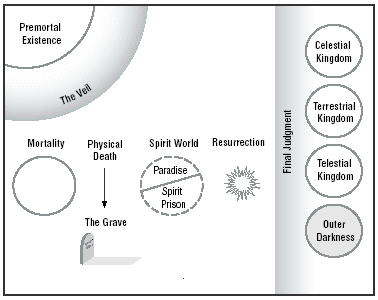
We started as spirits in the pre-mortal existence, were born into this mortal life, will eventually die, be resurrected and will be judged and allowed to enter a “kingdom of glory,” hopefully. As you can see, it’s a much broader view than that provided by most religions, who mostly teach of this life, a judgement, heaven and hell.
I find that having a broader view of how it all fits together explains a lot of the common challenges put to religion:
- Q: How is it fair that God would allow people to be born into such different conditions?
A: God provided our challenges and situations in this life based on who we were in the pre-mortal existence. - Q: Why would good people who don’t learn about Christ go to hell?
A: They will have a chance to learn about him in the spirit world. - Q: What’s the point of Heaven if you’re just sitting around on a cloud playing a harp?
A: Heaven is much more than an eternity of praise. It is the opportunity to become like God.
I realize that I am alluding to a lot of different details here that may be confusing if you haven’t already been taught this stuff. I will get to all of this eventually. My point here is to illustrate that the big picture view, provided by the Plan of Salvation, allows us to tie a lot of things together into a context where they make sense, when without that context they don’t seem to make sense in a world with a just and loving God.
This plan was laid out for us before the Earth was formed. God essentially said, “I have a plan to help you all become like me. It will be extremely difficult, will take eons and will result in many of you failing to attain that goal.” We are God’s children, and he wanted to provide us with the best opportunities he could provide. He also desires our happiness. This is why the plan is also sometimes called the great plan of happiness. Even for most of those who fail, the reward is the greatest degree of happiness He can provide.
Ultimately, the main question the plan of salvation answers is, “what is the purpose of life?” The answer is, to learn how to gain true happiness.
Posts in this series:
- Part I: Overview (this post)
- Part II: Our Pre-Mortal Existence
- Part III: Our Life on Earth
- Part IV: Death, the Spirit World and the Resurrection
- Part V: The Judgement and Kingdoms of Glory
Why there is no Proof of God
As a devout theist, it feels somewhat heretical to say this, but, there is no proof of God’s existence. What I mean by that is that for all of the evidence of God’s existence, even taken together, it is not sufficient to incontrovertibly prove, once and for all, to all the world that God exists. There have been individuals to whom God has proven his existence, but for most human beings, if we choose to believe in God, there is an element of faith required to continue that belief.
I suspect this proposition is obvious to many who don’t believe in God, while some believers may resist it being stated this way. However, this is actually a very important point in LDS theology for three reasons.
First, we believe that one of the primary purposes of this life is to prove our character by how we act when out of God’s presence. Because the nature of God allows him to know our every move, the only way we could achieve the required independence was to be put into a situation where we could believe God was not there.
Second, in a world where all will inevitably sin, we will be judged with respect to our knowledge and understanding of what is right. So, it is a mercy to withhold this knowledge from those who would be condemned by it.
Third, the process of gaining faith is also central to our purpose in life. “The aim of education should be to teach us rather how to think, than what to think.” The same is true for our spiritual education. Learning to use faith in order to gain understanding and to grow as an individual is key to progression. Having the central tenet of religion be unknowable except through faith demonstrates the central importance of faith.
Ultimately, all of these points boil down to something central to what we believe is the purpose of life. We are here not by random chance or for God’s amusement. We were sent from God’s presence to prove our character and improve our minds. The final judgment will not be based on an arbitrary checklist, but rather on the person we have become through our life on this planet. For those who have chosen not to believe, God will use the same criteria, and has structured His intervention on this planet to give us the best opportunity He could give.
Are Mormons Christian?
For anyone who knows anything about Mormons, the answer to the above question is obvious. Yes.
So, the real question is, why are we still getting this question?
The people who declare that Mormons are not Christian are using a definitional argument. They are defining Christianity in a way that suits them and excludes us. As a general rule their arguments are generally along these lines:
- We don’t believe that the Bible is the only word of God.
- We don’t believe in the Trinity.
- They (those who call us non-Christian) are offended that we won’t accept their baptisms or other sacraments.
- They are offended that we proselytize other Christians.
Our divergence from other Christian religions on these points is significant, and makes us very different from them. Each of these points also stems from a much deeper core difference. For example, it’s not just the Book of Mormon that is additional scripture for us. We also believe anything spoken by prophets when they are fulfilling their callings is scripture, even talks given in General Conference by General Authorities is considered scripture. However, even when you consider these deeper differences there is nothing that reduces the role of Christ in our doctrine. We are very different from other Christian religions, but are still very much Christian.
Ultimately, it’s a desire to marginalize or denigrate our faith that motivates people to assert that we are not Christian, and ignorance that perpetuates the slander. Sure, we can try to simply retort, “yes we are,” but ultimately that carries little weight. What we need to fight is the ignorance and prejudice behind the assertion.
Next time someone asks you if Mormons are Christian, try getting some clarification. What do they mean by Christian? What do they know about Mormons? Why would you think that we are not Christian, despite the name of Jesus Christ in the name of our church? Once you get clarification, don’t shy away from our differences. Some people don’t like us because we are so different. Difference is explanatory. Our responses and our lives should show that we are Christian.
 The Logical Mormon